
Exploring Haitian tech

Builders TalkN°01

Wilderson Benjamin, Klavenn: “Parents, students and schools should no longer move forward separately”

Klavenn’s CEO explains how his team is building an operating system for Haitian schools, designed for phones first, usable offline and available in Haitian Creole, French and English.

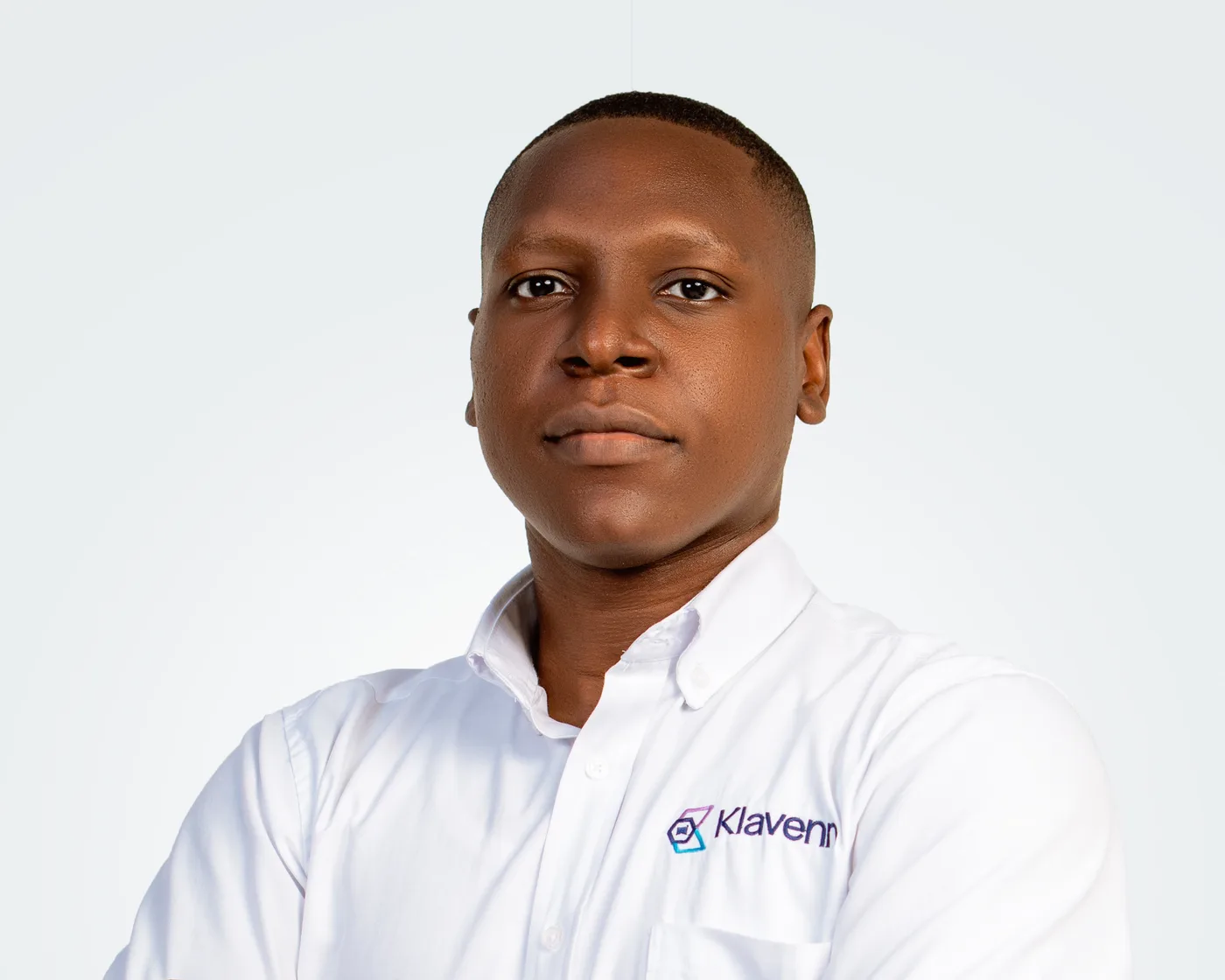
Wilderson BenjaminCEO of Klavenn
Wilderson Benjamin

Welcome to the very first Builders Talk on HaitiTechList, and I’m thrilled to kick it off with Wilderson Benjamin and what he’s building.

Wilderson and I had worked together years ago, but since then we’d only crossed paths occasionally on social media. Then I came across Klavenn, and it immediately stood out as a remarkable tech project for Haiti. It’s real, it has impact and a lot of potential, and it’s run by a highly skilled team that clearly cares about the details. You can see it in the design and in the early previews of the product.

I sat down with him for seven questions about how Klavenn got started, the technical choices behind it, how it keeps students’ data safe, and what’s next.

L’École. Réinventée!Video by Klavenn
  1. 01Could you introduce yourself, tell us how Klavenn was born and describe the team today: how many people, what profiles, and where are you based?

    Wilderson Benjamin

    There are countless stories of students and former students criticizing how their school is, or was, run: academic follow-ups that drag on forever, transcripts that are hard to track down, and so on. These difficulties don’t necessarily point to a lack of competence or commitment from school administrators. Above all, they show the need for better-suited tools.

    But what struck us most was not everything schools managed to accomplish despite tools that didn’t always keep up with their needs. It was everything they could accomplish with good tools.

    That conviction is what drives us at Klavenn. We believe parents, students and the school should no longer move forward separately. They are part of the same ecosystem and should be able to work together more easily to better support each student.

    We believe parents, students and the school should no longer move forward separately.

    Klavenn was born of this desire to bring technology closer to the day-to-day realities of schools. We want to help schools get better organized, gain visibility into their operations and strengthen their relationships.

    Klavenn is developed by Sadelica LLC, a US-based company represented in the Haitian market by Sadelica Haïti. The current team is five people with complementary profiles: Sajous Gelumer (founder of Sadelica and CTO), Wilderson Benjamin (CEO), Steevenson Tilus (CMO), Kendy Pierrot (COO) and Rivelt Larose (CCO). Although our team is somewhat spread out, we are currently based in Gonaïves.
  2. 02You describe Klavenn as an “operating system for schools.” In practice, which modules does it cover (enrollment, grades and report cards, tuition, communication with parents…)? And what sets it apart from the tools schools already use?

    Wilderson Benjamin

    We describe Klavenn as an operating system for schools because our ambition goes beyond managing a single activity. We want to offer an environment in which a school’s main operations, whether academic, administrative or financial, and the people who bring them to life can work together more coherently.

    Today, many schools still rely on paper to run their operations. Others use Excel, or a mix of different tools, to keep track of administrative information, academic results, payments and exchanges with parents. These methods can be useful, but they reach their limits as information piles up, responsibilities are shared among several people and the school needs an overall view of how it runs. Excel, for example, can be an excellent tool for managing data, but on its own it isn’t designed to coordinate a school’s entire ecosystem.

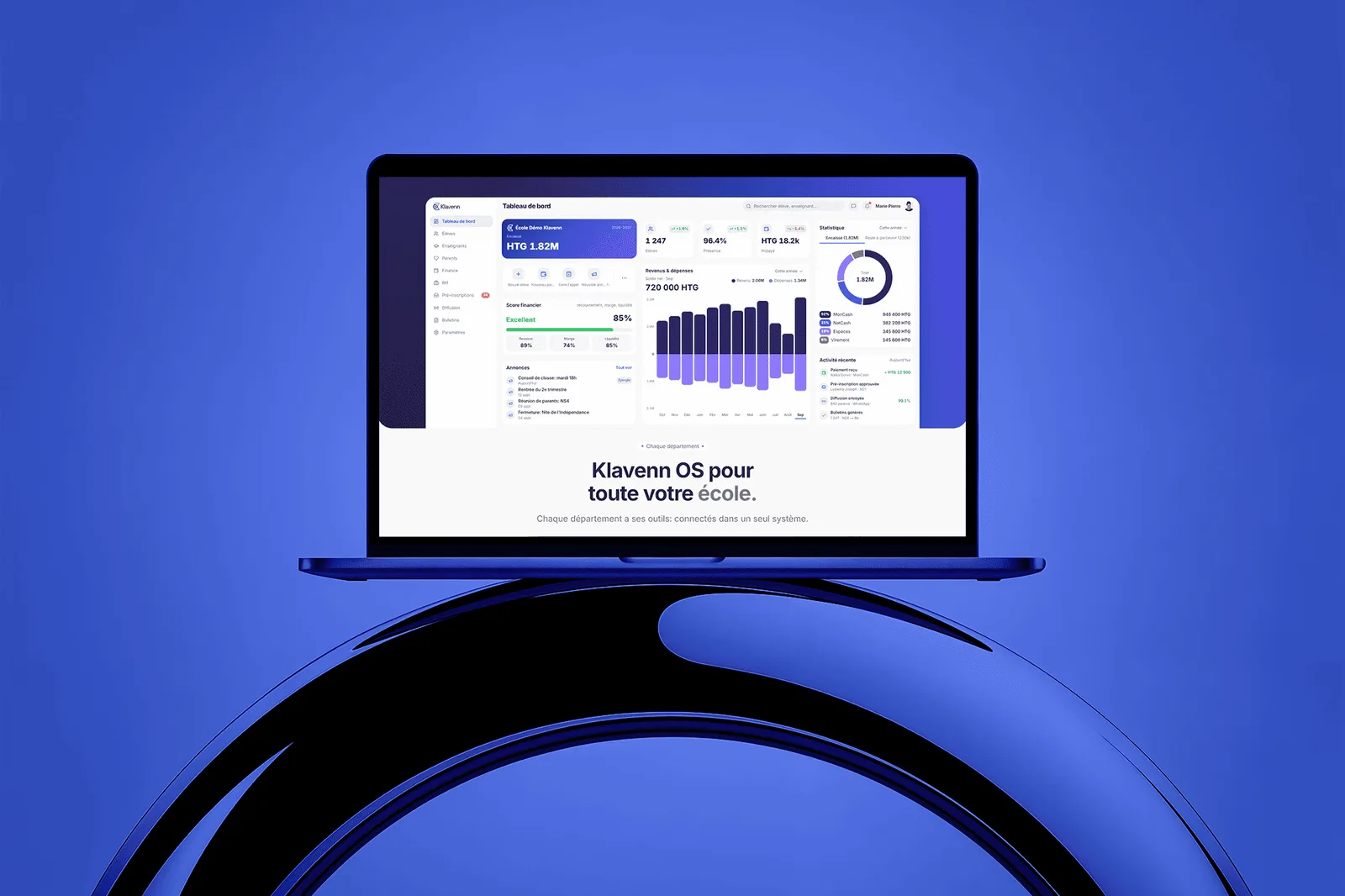
    The Klavenn dashboard on a laptop: “Klavenn OS for your whole school”

    With Klavenn, our goal isn’t simply to digitize school tasks; we want to bring a new school experience. What sets us apart is this holistic approach. We don’t see the administration, teachers, students and parents as isolated users, but as parts of one and the same ecosystem.

  3. 03What technical choices have you made (stack, web or mobile, hosting)? How does the platform handle conditions on the ground in Haiti, such as power cuts, unstable connections and entry-level devices? Is there an offline mode or deferred sync?

    Wilderson Benjamin

    Klavenn is a modern web platform, designed for the phone first. The same application runs:

    • in a browser, on a computer, tablet or smartphone;
    • as an installed app on iPhone and Android, distributed through the App Store and Google Play.

    Every update reaches all users at the same time, without a school having to install anything.

    Hosting relies on leading cloud infrastructure. The relational database is managed, and the application is served through a global content delivery network, which keeps response times short from Haiti. We designed Klavenn starting from conditions on the ground, taking unstable connections and power cuts into account.

    Klavenn works offline for day-to-day work. Screens you have already opened stay available without a network. Entries (attendance, grades, payments, student records) are saved on the device, then sent automatically as soon as the connection comes back. A teacher can therefore take attendance in a classroom with no signal: syncing will happen on its own, later. If there is a conflict, the server has the final say, so that no data is ever silently overwritten.

    Some actions can’t happen without a connection, and we own that: signing in to an account, an online payment (MonCash, card), uploading a file, clocking in an employee or scanning a badge at the entrance. Recorded later, they would carry the wrong time.

    The app detects modest phones (little memory, a limited processor) and automatically scales back its most demanding visual effects. The content and features stay the same, and pages are light, so they use little mobile data.

  4. 04Klavenn handles sensitive data, much of it about minors. What measures have you put in place: encryption, role-based permissions, backups, server location? And who owns the data: the school or Klavenn?

    Wilderson Benjamin

    We handle children’s data, so security isn’t optional; it’s the foundation. All traffic is encrypted (HTTPS). Passwords are never stored in plain text; only an irreversible fingerprint is kept. The most sensitive information, such as a school’s MonCash payment credentials, is encrypted with a bank-grade algorithm (AES-256). Klavenn can use those credentials to collect payments on the school’s behalf, but no one can read them back, neither our teams nor support.

    We handle children’s data, so security isn’t optional; it’s the foundation.

    As for role-based permissions, each person sees only what their role requires. On the administration side, the roles are management, accounting, human resources, front desk and IT. On the school side: teacher, parent and student. A parent sees only their own children, and a grade is visible to families only once the school has published it. Each school is also walled off: its data is never accessible to another school. To protect accounts, Klavenn offers two-factor authentication, app locking with Face ID and a log of sensitive actions.

    We have built a messaging service into Klavenn. Every user can report a message or block a sender. Reports are passed on to the school’s management.

    A full, automatic backup of each school is made every night, in private storage. The database also supports point-in-time recovery in case of a major incident. Data is hosted in the United States, with well-established cloud providers, in certified data centers. The technical providers we use are named publicly in our privacy policy.

    Who owns the data? The school, unambiguously. Legally, the school is responsible for its data, and Klavenn acts as a processor. We host and process it solely to provide the service, never for advertising or for sale. The school can export its data, and every user can delete their own account from within the app.

  5. 05Have you run pilot programs with schools? How many, of what kind (public or private, in Port-au-Prince or the provinces), and what have these tests taught you or led you to change in the product?

    Wilderson Benjamin

    The idea is to offer a solution that is genuinely relevant, so we first had to understand the realities of the people it is meant for. In that spirit, we talked with teachers, school leaders and others in the education world to better understand their daily challenges, how they work and what they expect from digital tools. These conversations deepened our understanding of the difficulties of running a school, notably scattered information, coordinating activities and the need to strengthen communication between the school and families.

    This listening phase was an important step in building Klavenn. It helped us test our vision against conditions on the ground and steer our approach toward real needs, rather than developing a solution from technical considerations alone.

    We are now entering a crucial stage, in which we want to bring the platform closer to the real setting where it will be used, work with interested schools and gradually gather their feedback. The next phases of collaboration with schools will let us assess the user experience more concretely, identify the adjustments needed and better measure the value Klavenn can bring to how they operate.

    For us, innovation isn’t about claiming to already have all the answers. It’s about listening and building methodically. We want Klavenn to evolve with the needs of schools and of everyone who contributes to education every day.

    For us, innovation isn’t about claiming to already have all the answers. It’s about listening and building methodically.
  6. 06Are you targeting Haiti first, or already thinking about the wider French-speaking market (West Africa, the Caribbean, Quebec)? Which languages is the interface available in, and what is your business model?

    Wilderson Benjamin

    We actually built Klavenn on international standards, and our vision is clear on that point. We are convinced the platform has room to grow in other markets, particularly across the Caribbean and, in time, beyond. However, we believe lasting expansion starts with a thorough understanding of our first market. That is why our priority today is Haiti.

    This international vision is also supported by the platform’s language accessibility: Klavenn is available in Haitian Creole, French and English.

    On the business side, we have adopted the software-as-a-service (SaaS) model, meaning software accessed online through a subscription. This model gives schools a school management platform without having to build and maintain a complete software infrastructure themselves.

    Our commercial approach is meant to reflect each school’s reality: its size, its operational needs, the number of users involved and the level of support it requires. The goal is to offer a solution whose value lasts over time, as schools expand how they use it.

  7. 07What are your priorities for the next 12 months, and what do you need most: funding, hiring, partner schools?

    Wilderson Benjamin

    Over the next 12 months, our priority is to take Klavenn from a solution that is ready to deploy to a platform that schools have adopted. Our first goal is to grow our presence in the local market. We want to build strong relationships with schools and support them as they bring Klavenn into their daily operations. It isn’t simply about adding sign-ups, but about making sure schools can truly make the platform their own and benefit from it.

    These first collaborations will be essential for strengthening our value proposition and refining our commercial approach.

    Our second priority is to consolidate our growth model. That means better understanding how much schools are able to invest and structuring our pricing. We want to build growth founded on trust and on real use of the platform.

    Finally, we want to gradually strengthen our operational capacity, on both the technical and commercial sides. To reach these goals, our most immediate need is to build a network of committed partner schools. We are looking for schools ready to explore new approaches to management and to help improve the solution through their feedback.

This interview was conducted in writing, in French, in October 2026. The answers were translated by HaitiTechList and lightly edited for clarity.